






Renovating floor or wall tiles without removing the existing covering is an increasingly popular solution in both home renovations and commercial premises. Laying new tiles over the existing ones saves time, reduces waste and significantly lowers the cost of the work. However, this technique only yields good results when the existing substrate is in perfect condition and has been properly prepared.
Before choosing the new tiles, it is important to assess the condition of the existing floor or wall and understand which adhesive to use, when a self-leveling compound is recommended, and in which situations the old tiles should be removed completely.
When can you install tiles over existing tiles?
It is not always possible to install new tiles directly over the existing surface. The success of the installation depends entirely on the condition of the substrate.
You can install new tiles over old ones when:
- The existing floor or wall tiles are firmly bonded.
- There are no hollow areas or loose tiles.
- The surface deviation is less than 5 mm when checked with a 2-metre straightedge.
- There are no active moisture problems.
- The additional floor height will not interfere with doors or access points.
On the other hand, the existing tiles should be completely removed when:
- More than 10% of the tiles are loose or cracked.
- Structural cracks are present.
- Moisture is coming from the substrate.
- The existing tiles are part of a waterproofing system that needs replacing.
- The increased floor height prevents doors from opening properly or creates significant level differences.
Check the condition of the substrate before you begin
Preparing the substrate is the most important stage of the entire installation. A poorly prepared surface will eventually lead to tile debonding or cracking.
Make sure the existing tiles are securely bonded
Tap each tile gently using the handle of a screwdriver or a rubber mallet. A solid sound indicates good adhesion. If a tile produces a hollow sound, it means there is an air pocket beneath it and it should be removed before continuing.
If more than approximately 10% of the tiles are loose, removing the entire existing tiled surface is generally the better option.
Check the flatness of the surface
Use a 2-metre straightedge to check for uneven areas on the floor or wall. Surface deviations should not exceed 5 mm. If they do, apply a self-leveling compound before installing the new tiles.
This inspection is especially important when installing large-format tiles, as they require much flatter surfaces to prevent lippage between tiles.
Rule out any moisture problems
Before installing new tiles, make sure there are no leaks or active moisture issues. In bathrooms and kitchens, pay particular attention to areas around showers, bathtubs and sinks.
If the existing tiled surface forms part of a waterproofing system (such as a bonded waterproof membrane system), it must be completely removed so that the waterproofing can be replaced before installing the new tiles.
How to properly prepare existing tiles
Repair damaged tiles
Any loose or detached tiles must be completely removed. Then remove the old adhesive and fill the void using a fast-setting repair mortar. Only once the substrate is fully stable should the installation continue.
Clean and degrease the entire surface
Tile adhesive requires a clean surface to achieve maximum bond strength. Remove grease, wax, soap residue and cleaning products using a suitable degreasing cleaner or hot water with an alkaline detergent.
After cleaning, rinse thoroughly with clean water and allow the surface to dry completely before applying the bonding primer.
If the existing tiles have a highly polished or glossy finish, lightly sand the surface to increase its roughness and improve adhesive performance.
Repair cracks before installing the new tiles
Small stable cracks should be repaired before installation begins. A levelling or repair mortar compatible with ceramic substrates is recommended.
If cracks continue to move or reappear shortly afterwards, they are likely structural. In this case, installing new tiles is not recommended until the underlying issue has been resolved, as movement will eventually transfer to the new tiled surface.
Apply a bonding primer
A bonding primer significantly improves adhesion between the existing tiles and the new adhesive. Although some manufacturers allow direct installation over ceramic surfaces, using a bonding primer remains one of the best practices for achieving a durable installation.
Apply the primer evenly with a roller or brush and always follow the manufacturer's recommended drying time before laying the new tiles.
Is a self-leveling compound necessary?
If the substrate has irregularities greater than 5 mm, applying a self-leveling compound before tiling is highly recommended. This creates a perfectly flat surface and helps prevent uneven tile edges.
Keep in mind that the thickness of the leveling compound will also increase the final floor height, so the total build-up should be calculated beforehand.
Which adhesive should you use for tiling over tiles?
The adhesive is one of the most critical elements of the installation. Not all tile adhesives provide sufficient bond strength for installation over existing ceramic tiles.
As a general rule, the following are recommended:
- C2 adhesive: provides improved adhesion and is suitable for most renovation projects over existing tiled surfaces.
- C2S1 or C2S2 adhesive: recommended for large-format tiles, bathrooms, kitchens, terraces, underfloor heating systems and surfaces subject to slight movement.
Flexible adhesives better absorb stresses caused by temperature changes and reduce the risk of tiles becoming detached over time.
For tile sizes larger than 30x30 cm, it is advisable to use the double buttering method, applying adhesive both to the substrate and to the back of each tile.
How to correctly install the new tiles
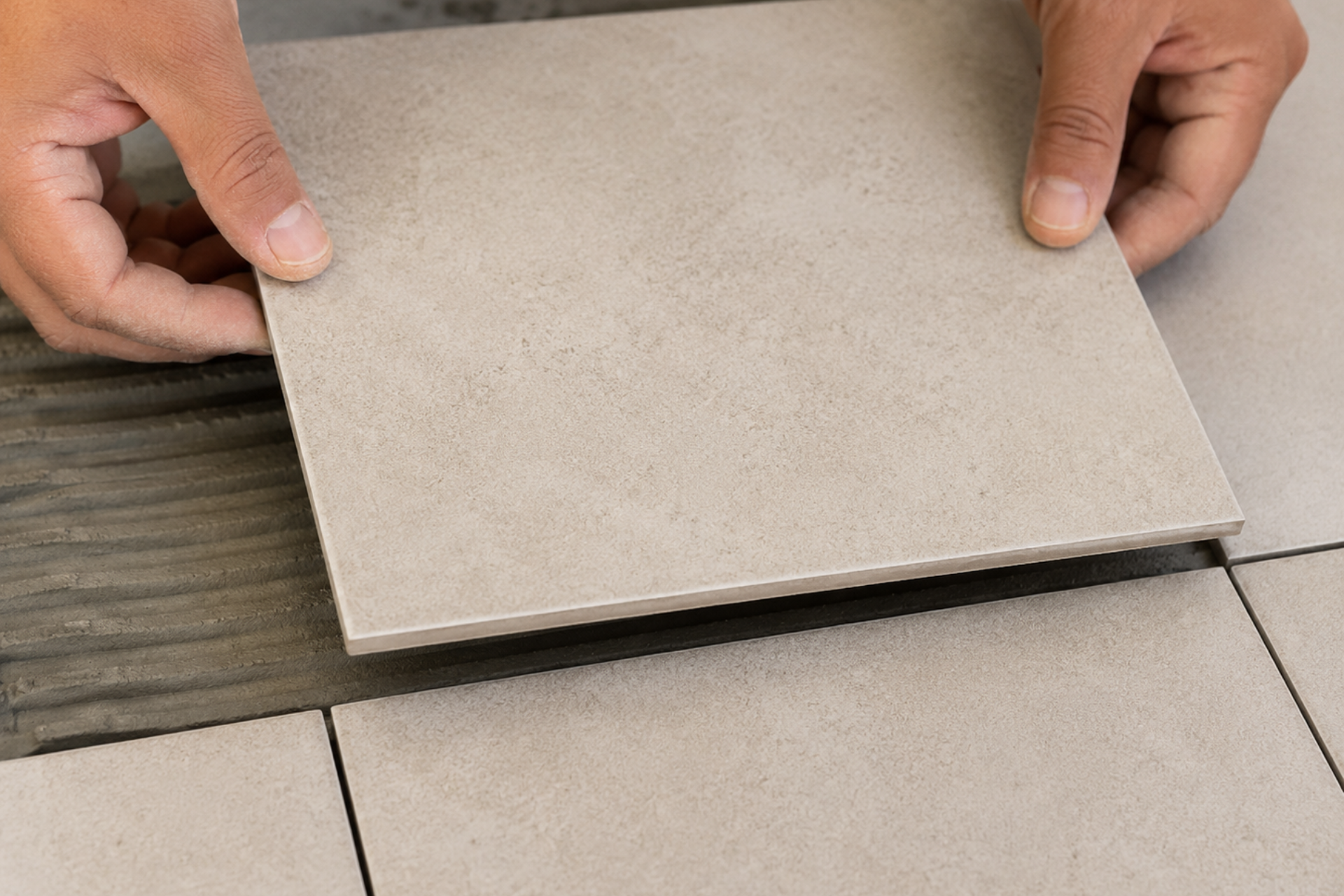
Once the substrate has been prepared and the bonding primer has completely dried, installing the new tiles follows almost the same procedure as laying tiles on a conventional substrate.
Spread adhesive over small sections only to prevent skin formation before placing the tiles. Use a notched trowel suitable for the tile size and keep the trowel lines running in the same direction.
Place each tile while applying gentle pressure and slight side-to-side movements to ensure full adhesive coverage.
Regularly check the level using tile leveling systems and spacers whenever necessary, especially when installing rectified or large-format tiles.
Grout the joints correctly
After the adhesive has cured for the time recommended by the manufacturer, grout the joints using a flexible grout suitable for the installed tile type.
At junctions with walls, bathtubs, shower trays and countertops, it is recommended to use an elastic silicone sealant to absorb minor movement caused by thermal expansion.
Once grout residue has been cleaned away, allow the floor to dry completely before exposing it to normal foot traffic.
A fast and durable renovation when the substrate is in good condition
Installing new tiles over existing ones is an excellent way to renovate bathrooms, kitchens and other spaces without demolition work. Besides reducing installation time and construction waste, it provides a completely refreshed finish with a lower overall investment.
However, the success of the installation depends entirely on proper surface preparation. Carefully inspecting the substrate, applying the correct bonding primer and selecting a high-performance tile adhesive are essential steps to achieving a durable and long-lasting result.
At Ceramic Connection, you'll find a wide range of porcelain tiles, ceramic wall tiles and floor tiles ideal for renovation projects, available in a variety of sizes, finishes and styles to suit every space.
Related posts
